Throughout our lives, many things can cause you to lose your teeth. From accidents to illness, to simply aging, nearly all of us eventually face an important decision: how do I replace the tooth or teeth I’ve lost? When weighing dental implants vs dentures, the right choice depends on your budget, your remaining jawbone health, and how natural you want the result to look and feel.
If you’re looking to replace one or more of your teeth, you have two primary options available to you: dentures and dental implants.
At first glance, making this choice can seem overwhelming. After all, it isn’t like a regular product where you can simply take it back and replace it if you don’t like it. Before making a final decision, you have to consider several factors, like personal preference, price, your remaining teeth, and even your existing jaw health.
In this article, we’ll go over the pros and cons of both dentures and dental implants, explain the differences between them, and help you make your choice.
Here’s our take on dental implants vs dentures:
Dental Implants Vs. Dentures: Do I Need Either?
Before you start deciding between dentures and dental implants, you should first make sure you need (or want) them. It’s important to understand the procedures of each one as well so you know what you’re getting yourself into.
Dental implants and dentures each have their own unique procedures, advantages, and disadvantages. You’ll want to discuss all of the details you find in this article with your dentist. With professional advice, you may even decide neither are for you and you want something like dental bridges instead. It’s in your best interest to be as informed as possible.
What are they used for?
Dental Implants and Dentures are used for essentially the same purposes. Things like:
- They help you chew tough foods you otherwise couldn’t
- They support your facial muscles
- They improve self-esteem and help decrease feelings of self-consciousness
- They improve your ability to speak and form certain syllables
Despite their similar uses, though, there are also significant differences between the two. Here are the ones you should be aware of:
The right choice between implants and dentures comes down to your bone health, budget, and how you want your smile to feel day to day.
Cost of Dental Implants Vs. Dentures
Implants
Between the two, implants are the more expensive option. Prices will vary depending on your dental office, location, and other factors, but you can generally expect implants to cost between $1,600 and $2,200 per tooth according to the American Dental Association (ADA).
Dentures
Dentures are harder to maintain, but they are much easier on your wallet. Instead of being charged per tooth, they are charged per unit. For reference, an upper or lower set is a single unit, while a full set (both upper and lower) is considered two units.
For one unit, the ADA suggests that the cost ranges around $1,600, regardless of whether it is upper or lower.
Comparing the Procedure: Dental Implants Vs Dentures
Implants
Dental implants are screw-like attachments that resemble teeth. They require enough remaining bone to securely attach to, otherwise you risk them falling out. Their popularity has also grown among adults 55 to 64, nearly rivaling dentures in this age group.
The implant procedure begins with removing your tooth’s damaged root. Once it’s gone, your dentist drills a hole into your jawbone where the implant will sit.
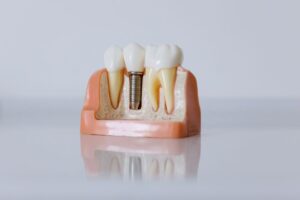
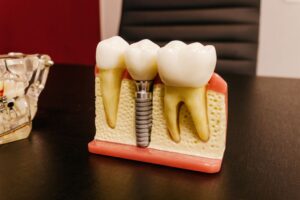
The implant itself is made of three distinct parts: the post, the abutment, and the crown. The post is a metal piece that screws into your jaw bone. The abutment is a piece that sits on top of the post, and the crown is built around the abutment and made to match your existing teeth.
Once the hole is drilled, the post is screwed into the bone. Then, depending on your dentist, the abutment may go ahead and install the abutment, or they may wait until you’ve healed first. Regardless, your bone has to heal around the post before the crown itself is installed.
Depending on how you heal and how your body reacts to the procedure, it could be anywhere from a few weeks to a few months before you’re ready to have the crown fixed on. This is by far the biggest disadvantage to implants, as you will temporarily have an empty socket where the crown will be. If you’d like a closer look at the process, our dental implants page walks through what to expect.
Dentures
Unlike implants, dentures are both removable and available regardless of how much bone is present. They are made to fit your mouth specifically, and can be created for entire mouths or small sections of your mouth where teeth are missing. They are made to look like real teeth and are bonded to your gums using a temporary adhesive you will apply every time you put them in.
Dentures are created by first taking an impression of the inside of your mouth using a nontoxic material called alginate. They may just do impressions of either the top or bottom of your mouth if you only need a partial set, or they could take a full impression panel for a full set.
Once your dentist has the impressions, they will look at your bite and jaw alignment to determine the best length for your dentures so your chewing and speech are minimally affected.
After that, your dentist will put in an order for a preliminary set of dentures to be made. Once they receive the order, they’ll put them in your mouth and check to see if they need any adjustments or extra alignment. Then, a final set will be made and you’ll be sent on your way! You can learn more about options on our dentures and partial dentures page.
Final Thoughts
While dental implants and dentures serve similar purposes, they certainly have their own advantages and disadvantages. Implants, for example, risk infection and mechanical issues. Dentures, however, are gentler and only really pose the risk of ulcers on the gums or coming loose at bad times.
Regardless, there are many things to consider when choosing your dental hardware. Your age, preference on function and feel, and hygiene all play a role in how well you’ll adapt to either one.
As such, we urge you to look carefully at your options, consult your local dentist, and consider your priorities so you can be confident in your decision. You can also browse our full range of dental services to see how implants, dentures, and other treatments fit into your overall oral health plan.
Frequently Asked Questions
What is the main difference between dental implants vs dentures?
Dental implants are permanently anchored into your jawbone and function like natural tooth roots, while dentures are removable appliances that rest on your gums. Implants typically cost more and require a longer healing process, but dentures are more affordable and don’t require surgery.
Are dental implants better than dentures?
Neither option is universally better — it depends on your bone health, budget, and personal preference. Implants tend to feel and function more like natural teeth, while dentures are a more accessible, non-surgical solution, especially when bone density is insufficient for implants.
Can I get dental implants if I don’t have enough jawbone?
Dental implants require enough remaining bone to anchor the post securely. If you don’t have adequate bone, your dentist may recommend bone grafting or suggest dentures as an alternative that doesn’t depend on bone density.
How long do dental implants last compared to dentures?
Dental implants are designed to be a long-term, often lifelong solution with proper care, while dentures typically need to be relined or replaced every several years as your mouth and gums naturally change shape.
Is the cost difference between implants and dentures significant?
Yes — implants are generally priced per tooth and cost more upfront than dentures, which are priced per unit. Your dentist can help you weigh the long-term value of each option against your budget.
Written by Dr. Janice Chaw, DMD — Dr. Chaw is the primary dentist at Plunkett & Chaw Dental in Dunwoody, GA. After earning her Doctor of Dental Medicine from Temple University in 2008, completing an Advanced Education in General Dentistry residency, and also achieving a Master of Public Health degree, she started practicing dentistry in the Atlanta area. In addition to general family dentistry, Dr. Chaw has extensive experience and has been one of the most recommended dentists in Dunwoody for dental implants, cosmetic dentistry, and full mouth reconstruction procedures.